
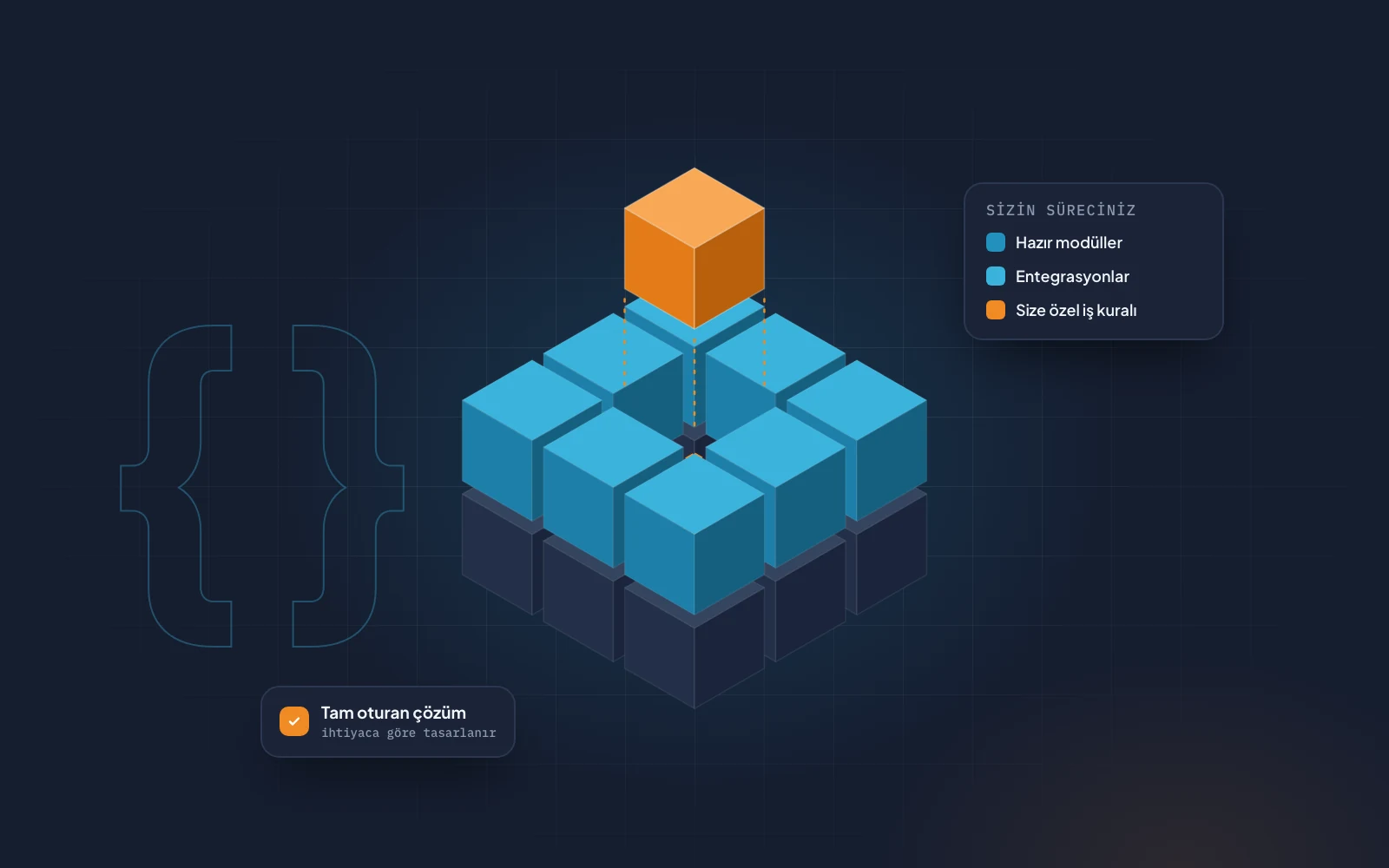
"Should I run my business processes on an off-the-shelf software solution, or invest in software built entirely for us?" Many businesses face this question as they grow and digitize. Custom software development delivers solutions that fully meet your business needs, integrate with your workflow and stay flexible over the long term. In this guide, you'll find the fundamentals of custom software, its pros and cons, the main cost items and the right software roadmap.
What Is Custom Software and How Does It Differ from Off-the-Shelf Software?
Custom software is built from scratch around a business's own processes, goals and approach. Off-the-shelf software refers to widely available products designed to serve general purposes across many industries.
- Custom software is designed around your workflow only; you don't have to adapt to a structure shaped by someone else's needs.
- Off-the-shelf software usually offers quick setup and a low upfront cost, but limitations can appear once you need extensive customization or integration.
- With custom software, ownership of the source code passes to you, so you can act independently during development and maintenance.
Which Businesses Is It Right For?
- Those that need systems working together (for example, businesses using both accounting and inventory tracking)
- Companies whose processes don't fit standard software packages
- SMBs with long-term plans for customization and growth
- Organizations that require sensitive data security and custom user management
When Can Off-the-Shelf Software Be Enough?
- Standard, short-term or early-stage business models
- Limited requirements in terms of cost, speed and operational scope
- Common core business functions already covered by existing industry packages
Advantages and Disadvantages of Custom Software Development
Advantages
- Fit: You can build a fully efficient system tailored to all of your processes.
- Integration flexibility: ERP, CRM, ecommerce, third-party APIs and other modules can be integrated easily.
- Security: Data storage, user authorization and access control are shaped entirely around your setup.
- Scalability: New features can be added as your business grows, and the system can be tuned as load increases.
- Source code ownership: Development, maintenance and licensing rights belong entirely to you.
- Maintenance and technical support: Support and updates can be tailored to your own processes.
Disadvantages
- The initial investment can be higher than for off-the-shelf software.
- Development time can grow depending on scope and level of customization.
- Ongoing maintenance and updates are needed, which may require dedicated resources.
Comparison Scenarios with Off-the-Shelf Software
A wholesaler tracking orders in Excel loses time with messy files as the business grows and increases the risk of errors. A custom order management system could speed up its processes, but in the early stages a simple inventory tracking program may be a better fit.
A travel agency that uses separate software for reservations, finance and customer tracking, and suffers from breaks in the data flow, needs a custom integration platform that unifies all of its processes.
An ecommerce site aiming to combine inventory and order management may hit data and transaction limits with off-the-shelf ecommerce packages as it grows. Custom software can deliver both strong optimization and flexible API integrations here.
ERP and CRM Applications in Enterprise Software
Enterprise resource planning (ERP software) solutions bring together inventory, production, accounting and human resources. CRM software makes it possible to track customer communication, quotes and the sales process from a single hub. With a custom software approach, these systems can be adapted directly to your business processes. Off-the-shelf ERP/CRM systems offer standard functions and may fall short of your specific needs.
You can also explore our ERP and CRM Software Development service.
API Integrations and SaaS Solutions
For businesses running multiple systems, being able to collect data in one place is a major advantage. API and System Integrations let you build dedicated connections to finance, logistics or business partners. In some industries, the SaaS (software as a service) model creates demand for fast rollout and cloud-based scalability. Still, a SaaS or API-based architecture isn't the most sensible choice for every project; the decision should be based on an analysis of your business model.
The Custom Software Development Process: Step by Step
- Needs analysis:
- Which operations will be digitized?
- Which systems need to be integrated?
- What are the target growth and security requirements?
- Design and Planning: User experience, interface design and workflows are defined. Modern technologies such as React and Next.js can be used here.
- Software development: Technologies such as PHP, Laravel and MySQL may be chosen for the backend, and React or Next.js for the frontend. Cross-platform solutions such as Flutter also come into play for mobile apps.
- Testing and Quality Control: All features and integrations are tested thoroughly.
- Go-Live & User Training: The system is launched and staff receive the necessary training.
- Maintenance and Support: A process is set up for ongoing updates, data backups and resolving technical issues.
For more details, take a look at our Custom Software Development and Web Application Development services.
Factors That Affect Custom Software Pricing
- Analysis and planning: Time and cost vary with the level of detail in your processes and requirements.
- Design: The user interface, reporting and the variety of features affect the cost.
- Development: The chosen technology stack (for example, Laravel, Flutter or React), integration needs and scalability are all taken into account.
- Integration: Connection points between your existing applications and the new software can add complexity.
- Testing and user acceptance: Test coverage and user training are reflected in both time and budget.
- Maintenance and support: Features developed over time or new technical needs can create additional costs.
- Licensing: If additional software or service licenses are required, the proposed total budget should cover them. With custom software, however, license fees usually disappear thanks to software ownership.
To get an exact price, your requirements need to be clearly defined and a detailed proposal prepared. You can send us your request through our Get a Quote page.
How to Choose the Right Custom Software Company
- Look at their experience with similar projects and the technologies they use (e.g., projects built with Laravel, PHP, React, Next.js, MySQL or Flutter)
- Team communication is vital as the project progresses. Working with companies that offer clear reporting and update processes tends to be more productive.
- Pay attention to documentation and the support services offered afterward.
- Always ask about post-project maintenance, training and update terms.
To learn more about our company, visit our About Us page.
Frequently Asked Questions
- Which of my business processes can be digitized with custom software?
Many processes, including operations, accounting, sales, customer relations, inventory and human resources, can be tailored entirely to your business. - Can I have custom software built only for the module I need?
Yes, software can be developed for specific modules or processes only. - Can I integrate my software with other systems later?
With proper planning, integrating solutions such as ERP, CRM, APIs and SaaS becomes possible. - Can my data be migrated when switching from off-the-shelf to custom software?
Data migration is planned specifically for each project during maintenance and integration, and is usually possible. - Am I locked in to the vendor for maintenance and technical support?
As long as you own the source code, you can get maintenance and development services from any team you choose.
Conclusion: Which Software Approach Is Right for You?
Don't rush a decision before clearly analyzing your business goals, scale, integration needs and growth vision. Starting with off-the-shelf solutions can make sense for simple business processes; but once your existing software starts holding you back, custom software development offers a more sustainable and manageable solution in the long run.
To determine the right approach and build a plan tailored to you, visit our Custom Software Development and Contact pages. Let's evaluate the best software path for your business together.
Author
Enes Şahin
Writes on the Hun Digital blog