
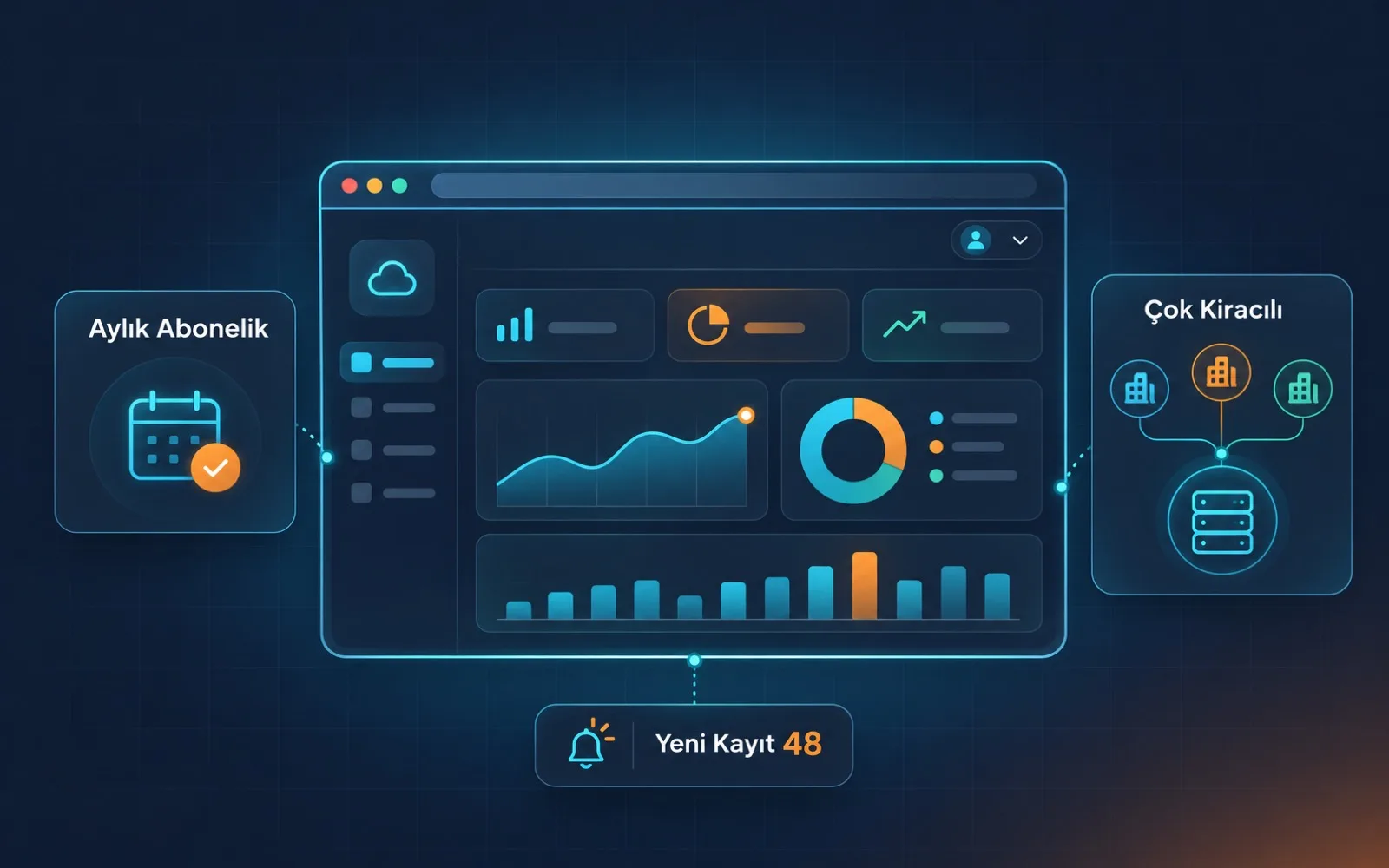
Using software from a browser for a monthly fee, instead of buying it and installing it on a computer, is now very common. SaaS is exactly the name for this model. In this article, we explain the concept in plain language, illustrate it with examples and lay out the development steps for anyone who wants to launch their own cloud product.
What Does SaaS Mean?
The acronym stands for Software as a Service. The software runs on the provider's servers. Users log in over the internet and pay a subscription fee.
Users don't deal with installation, servers, backups or updates. All of that is the provider's responsibility. When a new feature is released, everyone starts using it at the same time.
Everyday Examples
- Email and office tools: Email, document and spreadsheet apps that open in the browser.
- Online accounting and bookkeeping software: Issuing invoices and pulling reports from the browser.
- CRM and project tracking tools: Shared customer and task screens the team works on together.
- Ecommerce platforms: Systems like Shopify that let you open a store for a monthly fee.
- Industry-specific tools: Clinic appointment, booking or fleet tracking software.
What these examples have in common is that users work with the software without installing it or managing servers. A SaaS product usually solves one job well. It focuses on a clear need such as accounting, appointments or inventory. This way, even a small business can access the kinds of tools large companies use for a reasonable monthly fee.
How Is It Different from Installed and Custom Software?
Installed (on-premise) software runs on the company's own computer or server. The license is bought once, and maintenance and updates are left to the company. Custom software is built from scratch for a single company's needs and belongs to that company.
| Topic | Subscription cloud software | Installed software | Custom software |
|---|---|---|---|
| Users | Many companies | The company that buys the license | A single company |
| Payment | Recurring subscription | License fee | Project fee |
| Updates | Done by the provider | Done by the company | Depends on the agreement |
| Customization | Limited | Limited | Full flexibility |
We explained when custom software makes sense in our guide to custom software development. Sometimes a tool built for one company later turns into a product that can be sold to other companies as well. At that point, the business model changes.
To figure out which model suits you, ask three questions. How many companies will use the software? How similar are their needs? Who will handle updates, and how often? If many companies do similar work, the SaaS model makes sense. If there's a complex process unique to a single company, custom software may be a better fit.
How Does the Subscription Model Work?
With cloud products, revenue is recurring rather than one-time. Customers pay monthly or annually. As long as the product works well, customers stay and revenue builds up.
Pricing is usually split into several plans:
- Per user: A separate fee is charged for each additional user.
- Tiered plans: Feature tiers such as starter, standard and enterprise are offered.
- Usage-based: Fees are based on messages sent, orders processed or storage used.
- Free trial: Users try the product for a set period without paying.
The metric watched most closely in this model is customer churn. Keeping existing customers matters as much as finding new ones. That's why in-product guides, fast support and continuous improvement are part of the job.
What Is Multi-Tenant Architecture?
In a cloud product, each customer company is called a tenant. In a multi-tenant structure, all companies use the same application, but each company sees only its own data.
There are a few ways to do this. All companies can share a single database, separated by a company ID added to their records. Each company can also be given a separate schema or a separate database. A single database makes management easier. A separate database strengthens isolation but makes maintenance harder.
The choice should be based on the target number of customers, data sensitivity and the expectations of enterprise customers. If this decision isn't made correctly from the start, changing it later gets expensive.
How Do You Validate an Idea with an MVP?
An MVP is a minimum viable product. The goal is to see whether the idea actually sells before building every feature.
- Clarify the problem: In which industry, and whose job, are you making easier?
- Talk to potential customers: Ask how they do this work today and what they pay for.
- Choose the core flow: Identify a single flow that shows the product's main value.
- Release a small version: Start using it with a small number of pilot companies.
- Measure and adjust: Update the roadmap based on usage data and feedback.
If pilot companies aren't willing to pay, that's valuable information too. It gives you a chance to change direction before spending most of the budget. For budget planning, you can also take a look at our article on how software development costs are calculated.
What Should You Watch for in Scaling and Security?
As the product grows, the number of users and the volume of data increase. The infrastructure must be able to expand accordingly. Heavy jobs should be queued, frequently read data should be cached and server load should be monitored regularly.
Security is something to think about from day one. The key areas are:
- Strict separation of company data
- Role and permission management, with a two-factor authentication option
- Regular backups and a recovery plan
- Encryption of sensitive data and access logging
- Checking current regulations for obligations related to personal data
For products that process personal data, KVKK (Turkey's Personal Data Protection Law) obligations affect the product's design. We recommend getting an opinion from a legal advisor on this.
How Do You Set Up Billing and Payment Infrastructure?
In a subscription product, payments aren't just a single checkout screen. Card details must be stored securely, charges must run on schedule and failed payments must be retried. Plan changes and the cancellation flow also need to be considered.
For this, a payment provider that supports recurring payments is chosen. Invoicing is also connected to the accounting or e-Fatura (Turkey's electronic invoice) system. On invoicing and tax matters, you need to follow current GİB (Turkey's Revenue Administration) announcements and consult your financial advisor.
How Does Building a Cloud Product Progress?
We usually handle projects like these in four stages. In the first stage, the business model, target audience and core flow are clarified. In the second, the architecture, data structure and tenant model are decided. In the third, the MVP is developed and tested with pilot companies. In the final stage, scaling, additional modules and automations are added.
The core of the product is usually a web application. That's why web application development experience pays off directly. For industry-specific products, domain knowledge is also decisive. For example, in products focused on a narrow field, like the Seferya airport operations software, the flows need to match the day-to-day work of that industry exactly.
Will your product be just for your own company, or will it also be sold to others? If the answer isn't clear yet, starting with custom software development and later moving the product to a multi-tenant structure is also an option. But planning that transition from the start makes the work easier.
Frequently Asked Questions
- What's the difference between cloud software and a website?
A website mostly provides information and promotes. Cloud software is an application where users log in, do their work and enter data. - How much budget do I need to launch my own product?
The budget depends on the feature scope, integrations and design needs. Starting with an MVP is the healthiest way to keep the initial investment limited. - On which server should the data be stored?
The decision is based on target customers' expectations and the regulations. Some organizations may require data to be kept in-country, so this should be discussed from the start. - Do I need a mobile app too?
Not always. Most products start with a mobile-friendly web interface. If there's heavy use in the field, a mobile app can be added later. - Can enterprise customers ask for installation on their own servers?
They can. If the architecture is designed for it, the same product can also run in a separate environment for selected customers.
Conclusion
The software-as-a-service model offers recurring revenue and fast updates. But success depends on choosing the right problem, a solid tenant structure and a product experience that keeps customers. If you have a product idea, starting small and growing based on measurements is the lowest-risk path. To evaluate your idea together, take a look at our SaaS development page.
Author
Enes Şahin
Writes on the Hun Digital blog